Ethics of the Torah: The Rule of Law

Posted in | »

Imagine that we are peering through the lattice of King Shlomo's palace. Seated upon the massive throne of ivory and gold and lions and precious stones sits King Solomon himself. The rich smell of cedar panels mingles with the fragrances of perfumes. Here are silks and delicacies and everything delicious to the senses. Around the throne servants hurry and fuss to anticipate every need and whim of the king. Solomon in all his splendor indeed!

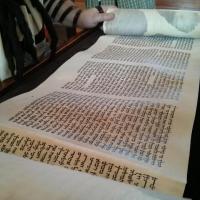
But what is the king doing? Standing before him are two priests holding aloft a scroll of Torah(Hebrew) instruction, guidance; specifically, the five books of Moses: Genesis, Exodus, Leviticus, Numbers and Deuteronomy. Often translated "law" or "Pentateuch". It is rolled open to the book of Devarim(Hebrew) literally "words"; the book of Deuteronomy. Spread across Solomon's throne is another roll of parchment over which the king is hunched, pen and ink in hand. He is writing; he is copying. He is writing a Torah scroll. He is fulfilling the special mitzvah(Hebrew) a commandment; a good deed of the king: to write a copy of the Torah.

The commandment for the king to write a copy of the Torah is found in Deuteronomy 17. In what is surely an amazing coincidence, Deuteronomy 17 just happens to be the very chapter of Torah which Solomon is copying as we spy on him! Even now he is beginning to copy down the special section of laws that apply to the King.

Therein it is written, "Now it shall come about when he sits on the throne of his kingdom, he shall write for himself a copy of this Torah on a scroll in the presence of the Levitical priests." (Deuteronomy 17:18). God commands the king to write a copy of the Torah. This provision is meant to insure that the king himself submit to the rule of law and not become a despot without accountability or boundary. Specifically, the passage says that he shall write a copy of the Torah so "that his heart may not be lifted up above his countrymen." (Deuteronomy 17:20). In other words, the king is subject to the laws of Torah just like everybody else in the kingdom. He has no sovereign exemptions. He has no royal exception or special immunity. By writing a copy of the Torah for himself, the king is reminded that he is not above God's law. In the eyes of the Torah, the king is just another citizen of God's kingdom.

The Rule of Law

This basic ethic of Torah is called the Rule of Law. It is similar to the way the constitution of a governing body is meant to function. In theory, a constitution is a document that presides over both the governed and the government. In the constitutional model, ultimate sovereignty is not vested within the government; it is vested in the constitution that formed the government. This is the theory of modern politics, as is well illustrated in the workings of the United States of America. The Constitution lays out the parameters for American government. Ostensibly, the government is only able to legislate and govern within those parameters. No government official is allowed to over-step the bounds of the Constitution. Government officials are subject to the rule of the Constitution and the legislation spawned by it, just as private citizens are. Without the rule of law, a government would be able to rule capriciously and without mitigation, as is often the case in economies where law has collapsed and violence has prevailed.

In God's economy, the Torah is the constitution that mitigates Israel's government. No one is above God's Torah because no one is above God. His word is the final authority, and even the king is not to transgress it.

The Smallest Letter

Knowing this, it is heartwarming for us to see King Solomon so busily engaged in this important mitzvah. But pay attention. Notice the bored and distracted expressions on the faces of the two priests who are supposed to be checking the king's work. Notice the sweat beading up on the king's forehead. Notice his nervous smile as he glances at the priests and then uses his finger to daub a jot of ink off of his scroll. It looks as if King Shlomo has just erased a letter from the passage he is copying! The priests overseeing the work don't seem to notice.

The words that the king is now supposed to be transcribing are, "And neither shall he multiply for himself wives that his heart shall not go astray." (Deuteronomy 17:17). But what has the king done? He has erased the little letter yud from the word yirbeh (multiply). The yud is a letter shaped like an apostrophe and no larger than one. It is just a small jot of ink. But in erasing that letter, Solomon has changed the whole meaning of the sentence. Now it says, "And he did not multiply for himself wives that his heart shall not go astray." By erasing the letter yud, Solomon has simply changed the tense of the verb "multiply." It is a small and subtle change. But now the verse is no longer an imperative forbidding a king to multiply wives. Instead, it has become a statement implying that his past-tense multiplication of wives will not have the effect of leading his heart astray! Shlomo has removed a jot.

An Important Midrash(Hebrew) Literally "study, searching"; a type of Jewish commentary that draws connections between passages of Scripture to derive lessons and laws, often through the use of parables and legends.

The above scene is more or less described for us in the Midrash Rabbah (Shemot 6:1). There we find a crucial midrash which not only relates this amusing anecdote about Solomon, but also informs our reading of the words of the Master in Matthew 5:17-19. The Matthew passage is, of course, the famous pro-Torah declaration, "Do not think that I came to abolish the Torah or the Prophets; I did not come to abolish but to fulfill. For truly I say to you, until heaven and earth pass away, not the smallest letter or stroke shall pass from the Torah until all is accomplished. Whoever then nullifies one of the least of these commandments, and teaches others to do the same, shall be called least in the kingdom of heaven; but whoever keeps and teaches them, he shall be called great in the kingdom of heaven." Within Messianic Judaism, this passage is often touted about with various shades of meaning. But its deepest implications are laid bare by the Midrash Rabbah and Solomon's unscrupulous scribal editing.

We will do well to spend some time analyzing this midrash and its relationship to both Deuteronomy 17 and Matthew 5. The first part of the midrash is as follows:

"When God gave the Torah to Israel, He inserted therein positive and negative commands and gave some commandments for a king, as it says: '[The king] shall not multiply horses to himself... Neither shall he multiply wives to himself, that his heart turn not away . . .' But Solomon arose and studied the reason of God's decree, saying: 'Why did God command, "He shall not multiply wives to himself?" Is it not "That his heart turn not away"? Well, I will multiply wives and still my heart will not turn away.'"

In his great wisdom, Solomon supposed he understood the reasoning behind the commandment. Why did the Torah command a king not to multiply wives? Clearly God intended this law as a safeguard for the king's heart. Solomon apprehended the principle of the law. He understood the intention behind the law against multiplying wives. He thus reasoned, "If I keep my heart from going astray, then I am free to multiply wives." Therefore, he felt at liberty to edit the text of the Torah enough to reflect his new insight into God's law.

According to this logic, Solomon was able to ignore the literal command not to multiply wives. In his mind, because he understood the principle of the law, he did not need to obey the literal meaning.

Solomon's logic may be amusing to us, but that is simply because he does not use our terminology. If the wise King Shlomo had possessed a copy of 2 Corinthians as we do, he could have simply quipped, "the letter kills, but the spirit gives life." No more rationalization would be necessary. In our terms, Solomon did not need to keep the letter of the law because he understood the spirit of the law.

A Complaint in Heaven

The midrash continues with the story of Solomon's edited version of the Torah:

"At that time, the yud of the word yarbeh went up on high and prostrated itself before God and said: 'Master of the Universe! Hast thou not said that no letter shall ever be abolished from the Torah? Behold, Solomon has now arisen and abolished one. Who knows? Today he has abolished one letter, tomorrow he will abolish another until the whole Torah will be nullified!' God replied: 'Solomon and a thousand like him will pass away, but the smallest tittle will not be erased from thee.'"

To recapitulate, the little letter that we saw Solomon blot out from his copy of the Torah was so offended that it ascended to God and filed a formal complaint against Solomon. The letter yud warned God that if this kind of editorial process were allowed to continue, the whole Torah would soon be abolished and nullified. God placates that letter yud by assuring it that not even the smallest decorative crown would ever be erased from the eternal Torah. God points out that Solomon and men like him are temporal and passing, but the law of God is eternal. Solomon may ply his wisdom and logic and creative scribal work as much as he likes, but God's law will still stand long after Solomon has disappeared.

The Master virtually quotes this midrash when he says, "Do not think that I came to abolish the Torah or the Prophets; I did not come to abolish but to fulfill. For truly I say to you, until heaven and earth pass away, not the smallest letter (yud) or decorative tittle shall pass from the Torah until all is accomplished."1

Cleaning Sewers

In the midrash, Solomon goes on to explain his rationale to us. Solomon says,

"The reason why God has said: 'Neither shall he multiply wives unto himself' was only lest the king's heart should turn away...God is with me, and I will withstand this temptation."

Solomon is confident that his own wisdom is superior to the rule of Torah. With a terrific sense of irony the midrash continues:

"Yet what is written of Solomon? 'For it came to pass, when Solomon was old, that his wives turned away his heart after other gods' (I Kings 11:4). R. Shimon Bar Yochai said: 'It would have been better for Solomon to clean sewers than to have this verse written of him.'"

(Having spent a good deal of the last several years engaged in the less-than-glamorous vocation of sewer cleaning, Shimon Bar Yochai's words carry extra color for me. The specific color I am thinking of is the black sludge that invariably accompanies a clogged sewer pipe. It never occurred to me as I labored for hour after hour over clogged sinks, tubs and toilets that I was better off than Solomon, but the midrash assures me that I was.)

In his wisdom, Solomon outsmarted himself. He assumed that because of his rational apprehension of Torah, he was above the rule of law. The thinking goes something like this: "I understand what the Torah really meant by such and such a commandment, therefore I don't need to actually keep that commandment."

For example, there are many who are quick to point out the health benefits of Torah's kosher(Hebrew) proper, permitted by Jewish law. Often used to describe food that it is permissible to eat. laws. I remember a time when it was not uncommon to hear the Christian teachers explain that the laws of clean and unclean animals that forbade Israel to ingest pork were because of the absence of refrigeration or any means of meat preservation in the wilderness. Having therefore determined the Torah's reasoning behind the commandment, we are clearly liberated from keeping this commandment, especially now in an age refrigeration and preservatives.

Again, we might be tempted to explain the law of the Sabbath as God's desire for man to take a break from a heavy workweek. Now understanding the Torah's intention behind the law of the Sabbath, it becomes clear that we need not keep the Sabbath on the seventh day as long we takes at least one day off a week. Furthermore, since it is the Torah's intention that we get the rest we need, if we aren't tired, we obviously don't need to rest and are free from the obligation of Sabbath.

We also find it convenient to spiritualize the commandments. The reasoning might typically proceed like this: "I understand the meaning of the Shabbat [(Hebrew) Sabbath; the seventh day of the week, which God blessed and set apart for rest and holiness.]. It teaches us about the Sabbath rest in Messiah. Therefore I am free from keeping Shabbat. I may celebrate Shabbat, but I don't need to keep the Shabbat, because I understand the intention of the Torah is to teach me about the Sabbath rest in Yeshua. So you see, since I understand the intention of the Torah, I don't need to keep the literal commandment." We have taken our cues from Solomon.

We could go on with endless examples of this kind of ridiculous rationalization, but I am certain we don't need to. We are all well enough familiar with the ingenious arguments we have constructed to exempt ourselves from the rule of law. Somehow, even those of us who identify ourselves as Torah observant or submissive find adequate immunity from the rule of law when necessary.

Madness and Folly

Regarding Solomon and the unfortunate outcome of his decision to abolish a letter from the Torah, the midrash continues:

"For this reason did Solomon say of himself: 'I turned myself to behold wisdom, and madness and folly.' (Ecclesiastes 2:12). Solomon said: 'Because I tried to be wiser than the Torah and persuaded myself that I knew the intention of the Torah, did this understanding and knowledge turn out to be madness and folly.'"

In the end, Solomon's great wisdom turned out to be madness and folly because he thought that he was wiser than the Torah. Through reinterpretation of the Torah, he was able to ignore the rule of law. In his estimation, he was above the literal meaning of the commandment because he understood the text at a deeper level. In so doing, his wisdom turned to madness and folly with bitter consequences in his life.

Are we in the Body of Messiah exempt from the rule of law?

It is true that we are not under the Torah in terms of our salvation or access to the family of God. The words of Rav ShaulThe Hebrew equivalent of Saul; often used in reference to Paul of Tarsus are very clear on this point. Grace is by definition a gift. Our salvation is a not contingent upon any particular commandment or behavior. Our righteousness is imputed to us, not created by us. There is no magical commandment or commandments that when properly observed will suddenly and mystically whisk us from the Kingdom of Darkness into the Kingdom of Light. Therefore we are not under the law as regards salvation.

But it would be madness and folly to assume that we are exempt from the rule of law, as Solomon did. It would be madness and folly to assume that by merit of our salvation we possess some special immunity to God's commands. It would be madness and folly to cavalierly reinterpret the commandments in such a way as to justify our own disobedience. The rule of God's law is an eternal ethic.

The Cost of Discipleship

When the previous American President Bill Clinton flaunted the rule of law in regard to his alleged perjury there was a great outcry from the Conservative Christians in the country. People were incensed that this man seemed to consider himself and his office to be above the Constitution and above the criminal court system created by the Constitution. It was called "a travesty of justice," and for many weeks the concept of "the rule of law" was at the forefront of conversation.

But many of us Conservative Christians that condemned the American President for not upholding the rule of American law routinely exempt ourselves from the rule of God's law! It is surely a classic case of a massive log in our own eye.

The Master anticipated our tendency to absolve ourselves, and that is why he chose to remind us of Solomon's folly when he said, "Do not think that I came to abolish the Torah...not the smallest letter or tittle shall pass from the Torah until all is accomplished. Whoever then nullifies one of the least of these commandments, and teaches others to do the same, shall be called least in the kingdom of heaven; but whoever keeps and teaches them, he shall be called great in the kingdom of heaven."

Without ever having read the midrashic version of Matthew 5:17-19 Dietrich Bonhoeffer, in his book The Cost of Discipleship, incisively explains Yeshua's words regarding the rule of law. He writes: "The law Jesus refers to is the law of the Old Covenant, not a new law, but the same law which he quoted to the rich young man and the lawyer when they wanted to know the revealed will of God. It becomes a new law only because it is Christ who binds his followers to it. For Christians, therefore, the law is not a 'better law' than that of the Pharisees, but one and same; every letter of it, every jot and tittle, must remain in force and be observed until the end of the world. Jesus has in fact nothing to add to the commandments of God, except this, that he keeps them. He fulfills the law, and he tells us so himself, therefore it must be true. He fulfils the law down to the last iota."

The thing that makes Bonhoeffer so unique among theologians is that he refused to trivialize and explain away the words of Yeshua. He is one of the few among us that actually took the Master literally. Bonhoeffer did not feel the need to be wiser than Yeshua. He did not try to be smarter than the Gospel. He did not substitute rationalization for obedience, and because of that, Bonhoeffer met martyrdom in the death camps of Nazi Germany while many fine and comfortable Christians were goose-stepping around with swastikas on their uniforms.

Bonhoeffer believed in the rule of law, and to him, a theology that did not confess the rule of law was theology of "cheap grace."

The Fundamental Ethic

The rule of law is the most basic and fundamental ethic of the Torah. Without the rule of law, the ethics of the Torah are reduced to simply good advice, something akin to fatherly counsel Polonius gives his son Laertes in Hamlet. Without the rule of law, the 613 commandments become the 613 suggestions.

Yet somehow, we take it for granted that the rule of law in Torah does not apply to us. In so doing, we place ourselves even above the kings of Israel. More than that, we place ourselves above Messiah, the ultimate King of Israel.

It is part and parcel of our theology that Messiah lived a perfect and sinless life in accordance with Torah law. We take it for granted that he did live a sinless life, and we readily admit that if he had at any point transgressed Torah, he would have ceased to be the perfect sinless atonement necessary. Indeed, according to Deuteronomy 17, if Yeshua is a true king of Israel, he must "keep Torah all the days of his life" and "carefully observe all the words of the Torah" and "not turn aside from the commandments either to the right or the left." In short, we readily affirm that Yeshua was not above the rule of law, even though he himself is, in respect to his Divine Nature, the Author of that law.

Yet while we hold the Master up to the rule of law, we still find means to exempt ourselves. In so doing we hold our king to a higher level of accountability than that to which we are willing to submit ourselves.

I am afraid that our shock at Solomon's devious erasure of the letter yud is more than a little hypocritical. We have erased whole sentences, verses and chapters of Torah because we have assumed ourselves to be wiser than the Torah. I am afraid our wisdom has turned to madness and folly. We have taken our cues from King Shlomo rather than from King Yeshua. If so, it would have been better for us to clean sewers than to play at theology.

  1. 1. But can we really draw a correlation between the words of Yeshua and a third-century midrash? It is a common error of critical scholarship to assume that the body of Midrash (written 2nd-5th century) is younger than the NT. The strength of the oral tradition is well attested within the early centuries of Rabbinic Judaism, and a couple of centuries is only a few generations of oral transmission. That midrash is concurrent and even predates the NT is evident from the NT's and early Targums' frequent uses of and allusions to various midrashic traditions.

Works Cited

  • Lehreman, S.M. trans. The Midrash Rabbah Exodus. London, New York: The Soncino Press. 1983
  • Bonhoeffer, Deitrich. The Cost of Discipleship. New York: Collier Books, MacMillan Publishing. 1959
Submitted by D. T. Lancaster on Sun, 08/17/2008 - 21:14