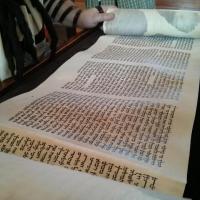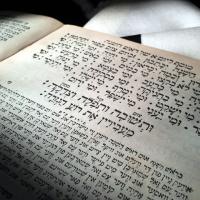
I find that we are often asked by our brothers and sisters why it is that we have decided to live out the Torah(Hebrew) instruction, guidance; specifically, the five books of Moses: Genesis, Exodus, Leviticus, Numbers and Deuteronomy. Often translated "law" or "Pentateuch" mode of our faith. Why don't you eat ham? Why do you keep Sabbath? Why do you do the Festivals? Why do you observe Jewish tradition?
Arguments come leaping to mind. I am trying to explain Acts 15 while batting off Galatians 3. I am trying to advance Leviticus 23 while being bludgeoned with Colossians 2. I am trying to talk Kosher while being whacked with Acts 10. I am trying to defend the Sabbath while Hebrews 4 is being used like a folding chair in a WWF match. Is there a simple rationale for a Gentile believer to live out the Torah life? Is there a simple explanation that does not involve a text-for-text disputation lasting into the wee hours of the night?
There is. It is the famous story of the Great Commission.
Eleven Disciples
It was spring and the sun was shining. Just west of Capernaum was a ridge of rugged hill that commanded a view of the Sea of Galilee and the coastal villages along its shores. Flowers were growing there. Clothed like Solomon in all his splendor, red anemones and the blue irises forced their way through the craggy soil of the hillside. Eleven awkward men climbed the grassy slopes with halting strides. They seemed uncertain of where it was they were going, and they often stopped to glance about. They were the Eleven, formerly known as the Twelve. They had come to this place, the Eremos heights, to find the Master.
It was on just such a sunny, spring day that he had first called them to follow him up the same grassy slopes. Hadn't he sat right over there while he taught? And wasn't in this same lonely and quiet place that they had often found him praying in the early hours? It was here that he had taught them to pray and taught them the meaning of discipleship. This is the mount of the Sermon on the Mount. Now they had come to find him again. But where was he? Would he really appear again? Would they see him again? They shuffled about, uncertain of what to do next.
Then they saw him striding toward them through the waving grass, like King Shlomo himself, with the sun on his hair and the wind in his beard. Their hearts leapt. The Master had come. They prostrated themselves before him.
The Four Imperatives He Gave the Disciples
We all know the scene well. It is the encounter in Galilee described in Matthew 28. It is the story of the Great Commission in which YeshuaThe Hebrew/Aramaic name of Jesus of Nazareth. (lit, "salvation") says to his disciples, "All authority in heaven and on earth has been given to me. Therefore go and make disciples of all nations, baptizing them in the name of the Father and of the Son and of the Holy Spirit, and teaching them to obey everything I have commanded you. And surely I am with you always, to the very end of the age." (Matthew 28:18-20).
The Commission is composed of four imperatives. The disciples are to:
- Go ye.
- Make disciples of all Gentiles.
- Immerse them in the Name of the Father and of the Son and of the Holy Spirit.
- Teach them to obey everything Yeshua commanded his disciples.
Out of these four, we must admit that the Christian faith has done a fairly good job with imperatives number one and three. However, points two and four have been largely bungled. We might term those two imperatives ('make disciples' and 'teach them to obey everything I have commanded') as the Great Omission of our historical approach to evangelism and conversion.
We can hardly be faulted if we have missed the mark a bit on that second and last imperative. Discipleship is an institution specific to Jewish culture. We didn't know what it meant. It was not possible to make disciples out of people when we didn't know what the term "disciple" meant in the context of late Second Temple Judaism. Furthermore, seeing as how our theologies became muddled with an anti-Torah bias, it was difficult for us to justify commanding Gentiles to obey everything Yeshua commanded. Especially when we ourselves were of the conviction that obedience to commandments was legalism and was at odds with the truth of the Gospel. Our Great Omission is a consequence of our separation from Judaism. It is a regrettable blunder on our part because it has shaped the character and quality of Christianity on a global scale.
Talmidim and the Art of Imitation
As he delivered the Great Commission to them, the Eleven were stretched out face down on the craggy turf before his bare feet. They were disciples. They understood what it meant to be a disciple. They had learned discipleship by sitting before those same feet for three years of education.
Our image of a disciple may be a flannel-graph picture of a bearded man in a robe and sandals, or it may be simply an image of one of the Twelve that followed Yeshua. We tend to think of discipleship as a New Testament, Gospel phenomenon, perhaps something Yeshua dreamed up when He chose his twelve disciples. This is wrong.
Long before the days of the Master, discipleship was already a well-established institution within Jewish culture. All the great sages, the rabbis, the sages among the Pharisees and the teachers of the Torah had disciples. The Hebrew word for disciple is talmid. Talmid means "student." The plural is talmidim: "students." We translate talmidim as "disciples." A talmid's job was to learn everything that his Master had to teach. The TalmudA major body of Jewish law composed between 200-500 CE. is a written transcript of several centuries of that process.
Disciples learned the stories that the teacher told. They learned the lessons that their teacher taught. They learned to eat the foods that their teacher ate, the way their teacher ate them. They learned to keep the Sabbath the way their teacher kept Sabbath and to give charity the way their teacher gave charity. They learned how to keep God's commands the way their teacher kept them. In short, they learned the halakah (walk) of their teacher.
A disciple's job was to become like his or her teacher. So it is written for us in the Gospel, "Every disciple fully trained will be like his teacher" (Luke 6:40). At its simplest, discipleship is the art of imitation. It is the art of walking (halakhicly and literally) after a teacher.
When the disciple was fully trained, he became the teacher and passed on the teaching to disciples of his own, who in turn, when fully trained became teachers and raised up disciples of their own.
Higher Education
Discipleship was the primary institution of higher-religious education in the days of the Master. There were no Bible schools. There were no seminaries. A young man seeking a future in teaching Torah would apprentice himself to a rabbi just as a would-be craftsmen would apprentice himself to a known master in order to learn a trade. In this case, the trade was Torah.
Even the apprentice analogy, however, falls short of describing the essence of the teacher-disciple relationship. That relationship was a powerful bond. Disciples regarded their teachers higher than their own fathers.1 They regarded themselves as servants (slaves) and their teachers as the master.2 Thus the disciples of the First Century referred to their teachers as Rabbi meaning "Revered One" or as Master. The teacher-disciple dynamic was also expressed as a 'father to son relationship'. In Rabbinic literature, the Torah sage is the Father and his disciples are called his family, hence terms like Beit Hillel "The House of Hillel." The collected words of the Torah Masters are called "Sayings of the Fathers."
The absolute dedication and loyalty disciples held for their teachers is incomparable to any of the pedagogic institutions of our own culture and experience. Imagine if, rather than falling asleep in your Freshman Composition class, you had instead begun to completely emulate the professor. You memorized his lectures and quoted him at every possible opportunity. You followed him to and from his home and often invited yourself to eat with him. You began to dress and act like him. You sought to absorb every possible nuance of his behavior. Obsessive? To say the least! Yet this was the prescribed mode of learning Torah in First Century Pharisaic Judaism.
The Four Jobs of a Disciple
In the First Century, the disciples of the Sages had four major tasks to perform. These tasks describe the cultural context of the institution of discipleship in the Gospels.
- To memorize their teacher's words. It was the job of a disciple to memorize his teacher's words. The oral transmission process was the only inter-generational communication practiced among the Sages. The great rabbis and Torah scholars of First Century Pharisaic Judaism did not write scrolls or compose books for their students to read and study. Instead, they taught orally and their disciples studied by memorizing their words. Through constant repetition, disciples memorized their teacher's words verbatim and were able to repeat them to subsequent generations.
- To learn their teacher's traditions and interpretations. It was a disciple's job to learn the tradition of how his teacher kept the commands of God and interpreted the Scriptures. Every detail about the teacher was important to the disciple. The disciple needed to learn how the teacher washed his hands, how he kept the Sabbath, how he fasted, how he prayed, how he gave charity, how he affixed a mezuzah, how he said the blessings over food, etc. Furthermore, the way the teacher interpreted passages of Scripture, the meanings he drew out, the parables with which he elucidated, the way he explained a verse or understood a concept, each of these was of utmost importance to the disciple. Details of this sort were not just trivia. To a disciple, these were like gems and pearls meant to be gathered and treasured.
- To imitate their teacher's actions. A disciple's highest calling was to be a reflection of his teacher. A disciple studied to learn, to act, to speak and to respond the same way his Master would act and speak and respond. A disciple studied to do the things his Master did. His highest goal was to walk after his teacher, that is to carry on and live out his teacher's halakah. "Every disciple, fully trained will be like his master."
- To raise up disciples. Ever since the days of the Great Assembly when the Sages were commanded, "Raise up many disciples"3 it was the job of a disciple, when finally trained, to raise up his own disciples. He was to create a new generation of students and to transmit to them the memorized words, traditions and interpretations and the actions and behaviors of his Master. The goal was to pass the torch of Torah from generation to generation.
You are Not to be Called Rabbi
But there is one large difference between discipleship to the Sages of Yeshua's day and discipleship to Messiah. In Matthew 23:8-10 Yeshua warns his disciples, "But you are not to be called 'Rabbi,' for you have only one Master and you are all brothers. And do not call anyone on earth 'father,' for you have one Father, and he is in heaven. Nor are you to be called 'teacher,' for you have one Teacher, the Messiah."
What does he mean when he tells us, "You are not to be called Rabbi or Father or Teacher"? How does that bode for Messianic Rabbis? How does it bode for teachers anywhere? What about our paternal fathers? What about our congregational elders? Does the Master mean that we should eschew all such titles? Is Pastor or Reverend permissible when Teacher and Rabbi are not? Is Elder permissible when Father is not?
The Master's words here can only be understood within the institution of First Century, teacher-disciple relationships as described above.
Each disciple, when fully trained, was expected to raise up his own disciples. He then became the teacher, the rabbi, the master, and the father to a new generation of disciples.
Yeshua forbids his talmidim to raise up disciples for themselves. They were not to be the teachers, rabbis, masters and fathers to the next generation of disciples. There was not to be a School of Peter, a House of Andrew, an Academy of James. There were not to be disciples of Beit Yochanan(Hebrew) the Hebrew equivalent of John. and disciples of Beit Nathaniel.
The disciples of Yeshua were never to assume the role of master, because unlike the masters of the Pharisees or the men of the Great Assembly or sages like Hillel or Shammai, Yeshua is still alive. Followers of Yeshua are forbidden to make their own disciples because our job is to raise up more disciples for Yeshua. For we have one teacher! The Messiah.
Ultimately, his words are not meant to forbid teachers among us, or elders, fathers, rabbis or even leaders. Of course we have and need all of these. But we must never let our elders, fathers, rabbis, leaders or teachers take the place of our one Master. We must never be the disciples of men. Rather, we are called to be disciples of the Messiah. Nor are we allowed to raise up our own disciples to satisfy our need for self-aggrandizement. Rather we must raise up more disciples for him!
The Discipleship of Paul
If any of the Apostolic writers understood the institution of discipleship, it was ShaulThe Hebrew equivalent of Saul; often used in reference to Paul of Tarsus of Tarsus. Discipled under the famous Sage Gamliel, he had spent the better part of his life learning the ins and outs of discipleship. Thus we should not be surprised to find that, as he kept the Master's Great Commission, he passed the discipleship model on to his congregations.
The congregation in Corinth was the first Assembly to formally separate from the Synagogue (Acts 18:7). Perhaps as a result, Corinth was beset with problems. Paul attributed their tendency towards deviancy to a lack of qualified men that might disciple them. In his first letter to that congregation he speaks about the death of "fathers" among them. He is not referring to paternal fathers.
I am not writing this to shame you, but to warn you, as my dear children.?you do not have many fathers, for in Messiah Yeshua I became your father through the Gospel.
Therefore I urge you to imitate me. For this reason I am sending to you Timothy, my son whom I love, who is faithful in the Lord. He will remind you of my way of life in Messiah Yeshua, which agrees with what I teach everywhere in every assembly. (1 Corinthians 4:14-17)
He regards himself as a father to both the Corinthians and to Timothy his disciple. The father-to-son language is characteristic of the Pharisaic teacher-disciple model. Furthermore, he urges the Corinthians to imitate him, thus spurring them on to live out their discipleship.
Later in the same letter, Paul explicitly refers to the oral transmission process of the teacher-disciple relationship as well as charging the Corinthians to imitate him even as he imitates Messiah. The oral traditions to which he refers are certainly the ways and words of the Master.
Follow my example, as I follow the example of Messiah. I praise you for remembering me in everything and for holding to the [oral traditions], just as I passed them on to you. (1 Corinthians 11:1-2)
Paul's discipling activities were not limited to the congregation at Corinth. To the Philippians he wrote, "Join with others in following my example, brothers, and take note of those who live according to the pattern we gave you." (Philippians 3:17). To the Thessalonians he wrote, "You know how we lived among you for your sake. You became imitators of us and of the Master...and so you became a model to all the believers in Macedonia and Achaia." (1 Thessalonians 1:4-7). By living out lives of discipleship to Yeshua, the Thessalonians had attracted the attention of others and won more converts to the path of discipleship. That's how it is supposed to work.
In his second letter to the Thessalonians he warned the believers to stay away from those who had abandoned the halakah and oral-tradition that he had taught and modeled while with them.
In the name of the Master Yeshua the Messiah, we command you, brothers, to keep away from every brother who is [walks disorderly] and does not live according to the [oral-traditions] you received from us. For you yourselves know how you ought to follow our example. We were not [disorderly] when we were with you. (2 Thessalonians 3:6-7)
From the above quotes and several others, it is plain that Paul regarded his converts as disciples. What was the halakah and oral-tradition that he taught his congregations? Wouldn't we like to know! What kind of halakah was he teaching them? Do you suppose he commanded them to affix their mezuzah horizontally or vertically? One never gets the impression that Paul bothered belaboring his converts with the minutia of legal disputation that characterized Pharisaic halakah. The halakah Paul taught was a life of imitation of Yeshua. It was discipleship at its simplest.
The Goose and the Gander
Yeshua commanded his talmidim to make disciples of all Gentiles and to teach them to obey everything he had commanded them. Disciples are more than just converts! Disciples are beholden to the expectations of discipleship. Yeshua's Great Commission is more than just proselytism; it is a command to raise up disciples in the name of the Master who will walk in the ways of the Master, learning his words, carrying on his traditions and raising up more talmidim for him. Paul accomplished this. He continually exhorted his converts to walk in imitation of him as he imitated Messiah.
You have probably heard the proverb "What's good for the goose is good for the gander." I call Paul's brand of radical discipleship the Goose-Gander Model. We are the Gander and the Master is our Goose. Whatever Yeshua said and whatever he did is good enough for us. We are to be imitators of Messiah.
Did he keep the Sabbath? Obviously he did. If it's good for the goose; it's good for the gander. Sabbath observance is part of our imitation of Yeshua.
Did he keep kosher(Hebrew) proper, permitted by Jewish law. Often used to describe food that it is permissible to eat.? Obviously he did. If it's good for the goose; it's good for the gander. Biblical Kashrut is part of the job of discipleship.
Did he keep the Passover? You get the idea. If we will be his disciples, we are obligated to imitate Yeshua. And that is the simple rationale for a Gentile believer to live out the Torah life.
In the Great Commission, Gentile disciples are directed to obey everything Yeshua commanded the Twelve. For those who are genuinely interested, it might be worth the trouble of pointing out that among those commands is the command to keep the Torah: every jot and tittle of it.4
Thus the call to the Kingdom is a call to the Torah of Yeshua. Discipleship is a call to imitation and obedience. We are called to be disciples of Yeshua, and as such it is our job to imitate him, obey him and raise up more disciples for him. The Sabbath, the Festivals, the calendar, the dietary laws and all the laws of Torah are components of imitation and obedience in that regard.
In his first epistle, Yochanan falls back on this Jewish model of discipleship as he gently coaxes his Gentile readers to take up the commands of Torah and the ways of the Master.
The man who says, "I know [God]," but does not do what [God] commands is a liar, and the truth is not in him. But if anyone obeys his word, God's love is truly made complete in him. This is how we know we are in him: Whoever claims to live in him must walk as Yeshua did. (1 John 2:4-6)
We need no further justification for taking up the commands of God than this: we must walk as Yeshua did. We must become disciples.